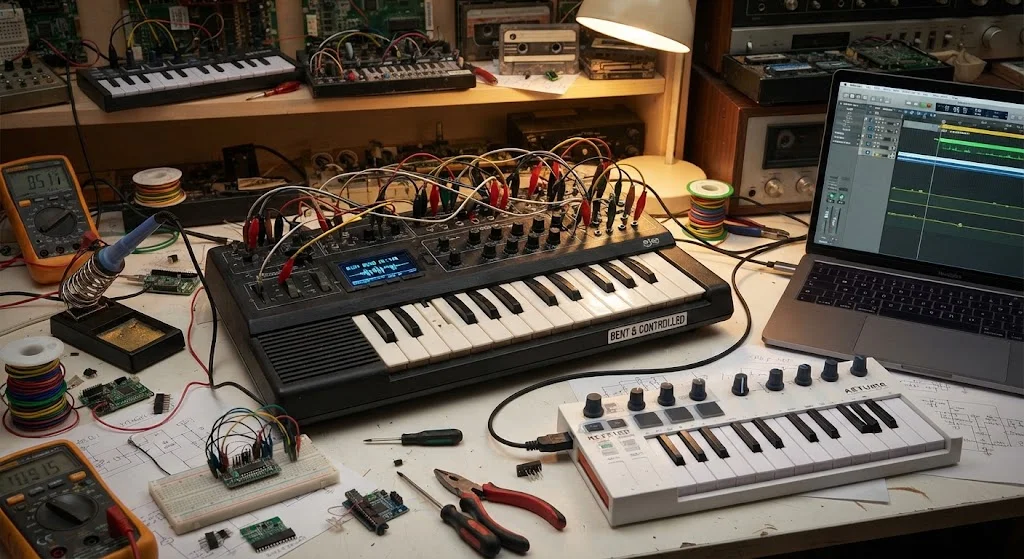
Circuit bending has always been about turning electronic devices into something they were never designed to become. A cheap keyboard can become a strange synthesizer, an old toy can produce unpredictable rhythms, and a forgotten piece of consumer electronics can become a completely new musical instrument. The appeal lies partly in the uncertainty: instead of following a fixed design, circuit benders explore what happens when the original electronic behavior is deliberately disrupted.
But there is an interesting shift happening in the circuit-bending community. Modern tools are making it possible to combine the chaotic character of bent electronics with the precision of MIDI control. Rather than simply turning a potentiometer by hand or connecting a switch to an interesting point on a circuit board, musicians can now experiment with controlling those modifications from a MIDI keyboard, sequencer, or computer.
From Random Glitches to Performable Instruments
Traditional circuit bending often begins with experimentation. A circuit board is opened, and low-voltage points are explored using wires, clips, potentiometers, switches, or other components. Some connections produce pitch changes, others create distortion, rhythmic glitches, unexpected oscillations, or complete system instability.
This unpredictability is one of the reasons circuit bending remains so attractive. However, it can also make a bent device difficult to perform. A particular sound might appear only when a potentiometer is positioned within a very narrow range, making it challenging to reproduce accurately during a live performance.
MIDI introduces another layer of control.
A MIDI controller can send precise values to an electronic circuit, allowing parameters such as resistance, pitch, modulation, or other bend characteristics to be controlled electronically. Instead of manually searching for the right position of a knob, a performer can use a keyboard or sequencer to automate the process.
Recent experimental projects have demonstrated this concept by using digital potentiometers to translate MIDI commands into variable resistance. This creates a bridge between conventional digital music equipment and unpredictable circuit-bent hardware.
Why MIDI and Circuit Bending Work So Well Together
At first glance, MIDI and circuit bending may seem like opposites.
MIDI is structured, repeatable, and highly controllable. Circuit bending is often experimental, unstable, and deliberately unpredictable. Yet that contrast can be extremely useful creatively.
Imagine connecting a modified toy keyboard to a MIDI controller. One MIDI control could gradually change a pitch-related parameter. Another could control a distortion circuit. A third could manipulate a voltage-starved section of the instrument. A sequencer could then automate these changes while the performer concentrates on playing.
The result is not necessarily a cleaner instrument. Instead, it becomes a more playable version of an intentionally broken one.
This approach is particularly interesting for musicians working with experimental electronic music, noise, ambient music, industrial sounds, glitch, and lo-fi production. The imperfections remain part of the instrument, but the performer gains much more control over them.
The Rise of Hybrid Hardware
Circuit bending has always existed somewhere between electronics, music, and visual art. Modern makers are extending that idea by combining old hardware with inexpensive microcontrollers, MIDI interfaces, digital potentiometers, sensors, and other contemporary components.
An old battery-powered synthesizer might retain its original sound-generation circuitry while a small controller is added to manipulate selected parameters. A toy could keep its original keyboard but gain MIDI connectivity. A video device might be modified to produce deliberate synchronization errors while external controls determine when those glitches occur.
The important part is that the original hardware does not necessarily have to be replaced. Its limitations and imperfections can become the foundation of the new instrument.
This philosophy also fits naturally with the broader maker movement. Instead of throwing away obsolete electronics, experimenters can repurpose them and discover new uses for hardware that would otherwise be considered useless.
Finding Inspiration Outside Traditional Electronics
One of the most interesting aspects of modern circuit bending is how easily it crosses into other creative disciplines. A circuit-bent instrument can be part of a music performance, an installation, a visual-art project, or an interactive experiment.
Creative communities built around experimental technology are also increasingly connected through online platforms. For makers who enjoy discovering unusual digital projects, creative resources, and unconventional tools, exploring sites such as https://dotberry.com can provide additional inspiration beyond traditional electronics forums.
The technology itself is only part of the equation. What matters is the willingness to experiment with unexpected combinations.
Circuit Bending Is Becoming More Musical
For many years, the typical circuit-bending workflow was simple: find an interesting device, open it, locate promising points on the board, experiment with connections, and permanently install the modifications that produce useful sounds.
MIDI does not replace that process. Instead, it adds another dimension.
A musician can now think of a circuit bend not only as a modification but also as a controllable performance parameter. A potentiometer becomes a MIDI-controlled variable. A switch can become part of a larger performance system. A strange glitch can become an intentional event in a sequence rather than an accidental sound that may or may not happen again.
That changes the relationship between the performer and the modified hardware.
The goal is no longer simply to make electronics behave incorrectly. It is to create an instrument whose unusual behavior can be explored, controlled, and performed.
The Future of Experimental Hardware
The combination of circuit bending, MIDI, microcontrollers, and digital control suggests an interesting future for DIY electronic instruments. Traditional synthesizers are designed to provide predictable results, while circuit-bent instruments often thrive on unpredictability. Hybrid designs can potentially offer both.
A performer could have precise control over some parameters while deliberately leaving others unstable. A sequencer could repeatedly trigger a glitch while the underlying circuit remains sensitive to voltage, temperature, or other physical conditions. Sensors could turn movement, light, or touch into controls for a modified instrument.
This creates something that sits between an electronic instrument and an experimental machine.
That is perhaps the most exciting direction for circuit bending today. The technology used to control the experiment is becoming more sophisticated, but the creative philosophy remains remarkably simple: open something up, find out what makes it work, and then discover what happens when you make it work differently.
Circuit bending has never really been about breaking electronics. It is about finding sounds, behaviors, and possibilities hidden inside them. MIDI and modern control technology simply give today’s circuit benders more ways to bring those discoveries to life.